
To give you a better understanding of the EXIM business landscape.

The world depends on oil as an essential resource which continues to be needed for daily operations. Crude oil maintains its crucial function in transportation and manufacturing and energy production throughout the year 2026. Although renewable energy sources experience consistent growth, the world still relies on oil because complete replacement will require an extended period of time.
If you’re involved in trading, logistics, or market research, understanding crude oil export data helps you clearly see which countries are controlling supply and how global demand is shifting. It’s not just about numbers—it’s about knowing where the market is heading.
The general belief says that oil demand shows a downward trend, but actual conditions present a situation that requires deeper analysis. Some countries are decreasing their oil dependency, yet developing economies consume more oil because their industrial and infrastructure development proceeds.
Developed countries maintain their oil use across aviation operations, shipping activities, and their manufacturing sectors. The methods used to control supply operations represent the actual transformation taking place. Countries are becoming more strategic by managing their production output and building international partnerships and responding to international developments.
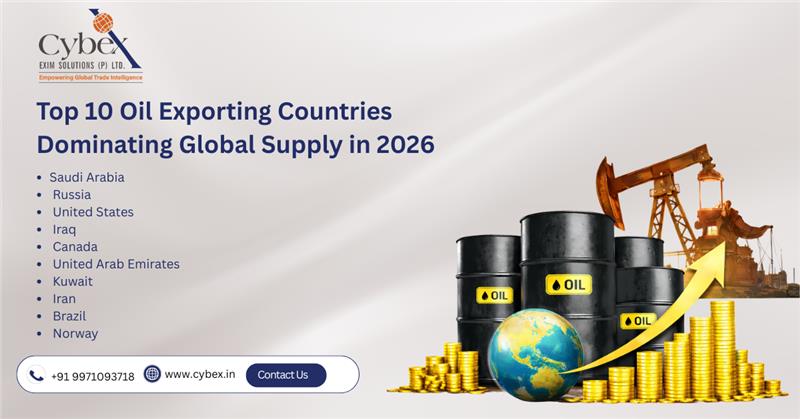
Here are the countries dominating the oil market in 2026:
1. Saudi Arabia
Continues to lead with massive reserves and strong control over production levels. It plays a key role in influencing global prices.
2. Russia
Maintains high export volumes despite geopolitical challenges. It has shifted focus toward Asian markets to stay competitive.
3. United States
A major exporter thanks to shale oil production. It has become a strong player in balancing global supply.
4. Iraq
Growing steadily and supplying key Asian markets. Its production capacity has improved significantly over the years.
5. Canada
Reliable exporter with strong ties to the U.S. Its oil sands production ensures a consistent supply.
6. United Arab Emirates
Expanding infrastructure and production capacity, making it a key global supplier.
7. Kuwait
Consistent exports with stable trade partnerships. It may be small, but its output is impactful.
8. Iran
Export levels vary due to political conditions, but it remains an important contributor to global supply.
9. Brazil
Rapid growth due to offshore oil production. It’s becoming a strong exporter in recent years.
10. Norway
A key supplier in Europe with stable output and high-quality crude oil.
It’s not just about having oil reserves. These countries succeed because they combine several important factors:
This combination gives them a strong advantage in the global market.
Asian economies have become one of the major changes which have occurred during the last few years. The world now relies on China and India as two of its biggest oil importing countries which drive international oil demand.
Exporters have improved their intelligence operations. They use market diversification to protect their business operations instead of focusing on a single geographic area. The oil trade now operates under increased competitive conditions, which creates dynamic market changes.
Using Global Trade Data helps businesses understand these trends better and identify where new opportunities are emerging.
Let’s be honest, guesswork doesn’t work anymore in global trade. The oil market moves too fast for that.
With the help of Trade data, businesses can:
For example, if a country suddenly increases imports from a specific exporter, it could indicate a long-term deal or a shift in supply preference.
Even though the oil market is competitive, there are still plenty of opportunities if you approach it smartly.
1. Emerging Markets
Countries in Asia and Africa are increasing their energy consumption, which means higher demand for oil imports.
2. Logistics and Infrastructure
As trade grows, the need for efficient shipping, storage, and transportation services is also increasing.
3. Smart Business Decisions
Companies using export data are able to identify trends early and make better decisions compared to competitors.
4. Energy Diversification
Some oil-exporting countries are also investing in renewable energy, opening new business opportunities.
Of course, the oil export industry isn’t without challenges:
But these challenges also create opportunities for businesses that stay informed and adaptable.
The global economy will maintain its dependence on oil as the primary energy source throughout the future. Renewable energy sources will experience growth, yet the demand for oil will remain constant throughout multiple regions particularly in developing nations.
The nations that successfully adjust to market changes through infrastructure development and supply chain management will maintain their position as market leaders.
The oil export market in 2026 presents both competitors and new business opportunities. The study of leading countries and evolving trade patterns enables businesses to establish market advantages.
Success in this industry requires companies to possess proper commercial knowledge at essential moments.
1. Which country exports the most oil in 2026?
Saudi Arabia remains the top oil exporter due to its vast reserves and ability to control production levels effectively.
2. Why is crude oil still important despite renewable energy growth?
Because many industries, especially in developing economies, still depend heavily on oil for transportation, manufacturing, and energy needs.
3. How can businesses benefit from oil trade insights?
By analyzing market trends, identifying buyers, and understanding supply-demand patterns, businesses can make smarter and more profitable decisions.
4. What are the biggest challenges in oil exports?
The main challenges include price volatility, geopolitical tensions, environmental regulations, and increasing global competition.
5. Which regions are driving oil demand in 2026?
Asia, particularly China and India, continues to be the largest driver of global oil demand due to rapid industrial and economic growth.
